Finishes
Stamped concrete vs pavers for a Colorado Springs patio.
An honest look at stamped concrete and pavers on Colorado Springs clay: frost, cracking vs shifting, weeds, repairs, sealing and ice melt.
Read the article →
Finishes
How each finish is made, what fades, what gets slippery, how often to reseal, and where each one fits around a Colorado Springs home.
By CO Springs Concrete · Updated September 2026 · 8 min read
Stamped vs stained concrete is really texture versus color. Stamped concrete is pressed with patterned mats while it is still fresh, so it takes the shape of stone, brick or wood, with color mixed in or floated into the top. Stained concrete is a finished slab colored after it cures. Both need sealer, and for outdoor slabs that get shoveled, PCA guidance is more cautious about stains.
Colorado Springs adds strong sun, snow, freeze-thaw and ice melt to the test. Here is how each finish is made, how it holds up, and where it fits.
Stamping happens on pour day. The Portland Cement Association's guide to decorative slabs describes patterns pressed into partially set concrete with imprinting tools, about an inch deep, all finished before the concrete hardens.
Color goes in one of two ways, or both. Integral color is pigment added as the concrete is batched, so it runs through the full depth of the slab. A color hardener is a colored powder broadcast onto the fresh surface and floated in. Sika's data sheet for one hardener says it leaves a surface harder and more abrasion resistant than ordinary concrete.
A release agent keeps the mats from sticking and tearing the surface. A powdered antiquing release adds a darker second color, and some of it stays in the low spots after washing, which gives the pattern depth.
That is why stamped concrete can only happen on a new pour.
Staining happens after the concrete cures. There are two main types.
Reactive (acid) stains are acidic solutions of metallic salts. PCA explains that they react with calcium hydroxide in hardened concrete, forming colored compounds that become a permanent part of the surface. Colors run to browns, golds, blacks and blue-greens, and PCA says to expect color that is not uniform.
PCA recommends at least 14 days of curing before staining, and one acid stain maker calls for 28 days. Curing compounds must stay off, because they block the stain.
Water-based stains and dyes do not react with the concrete. They give more control and colors acid stains cannot make, such as reds and yellows. Euclid Chemical's data sheet for one describes UV-stable iron-oxide pigments with a semi-transparent look.
Both types are see-through. Trowel swirls, patches and blemishes show through, and Euclid says its stain should not be used to cover unsightly stains. An acid stained concrete patio looks best on new or very clean concrete.
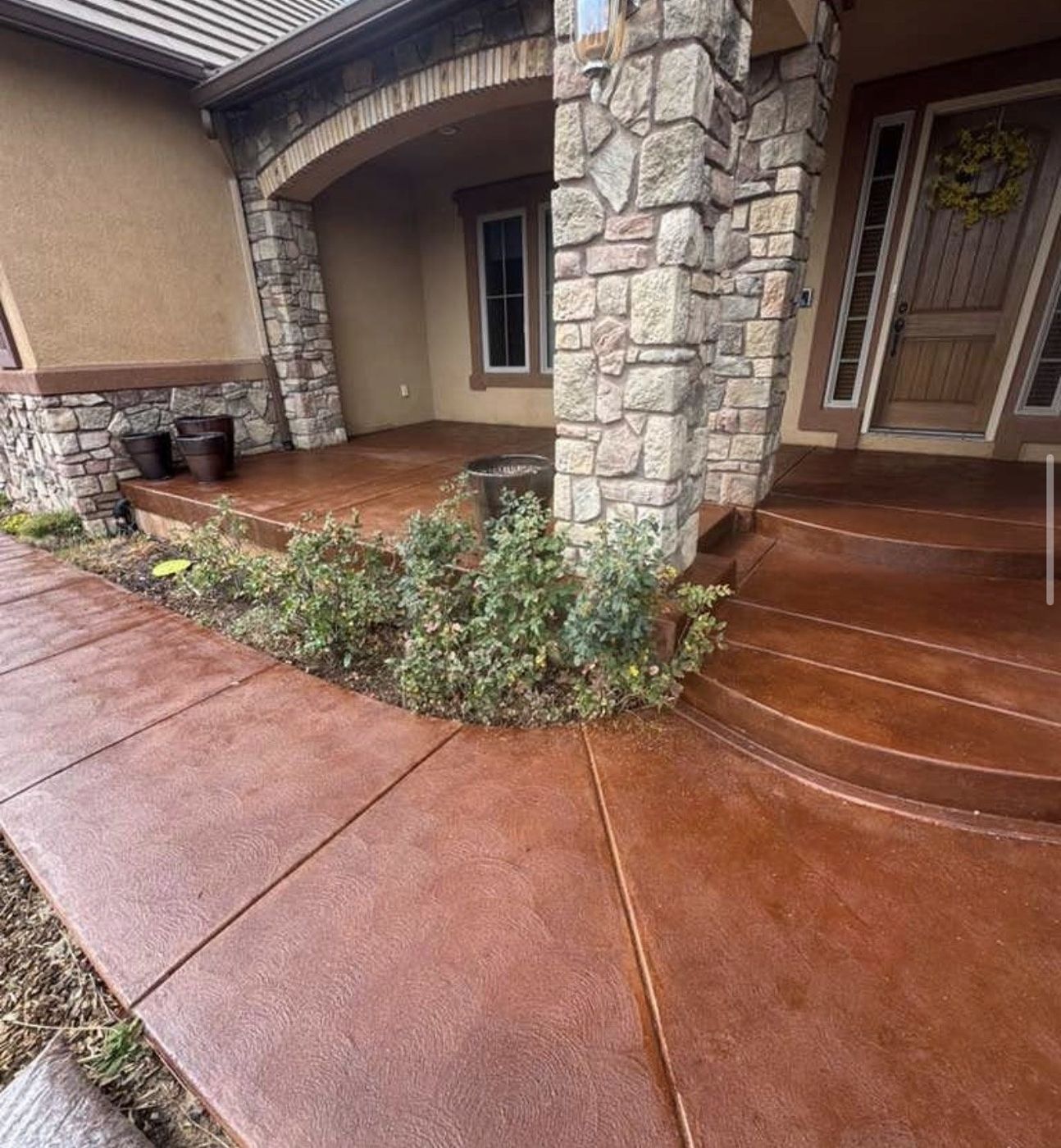
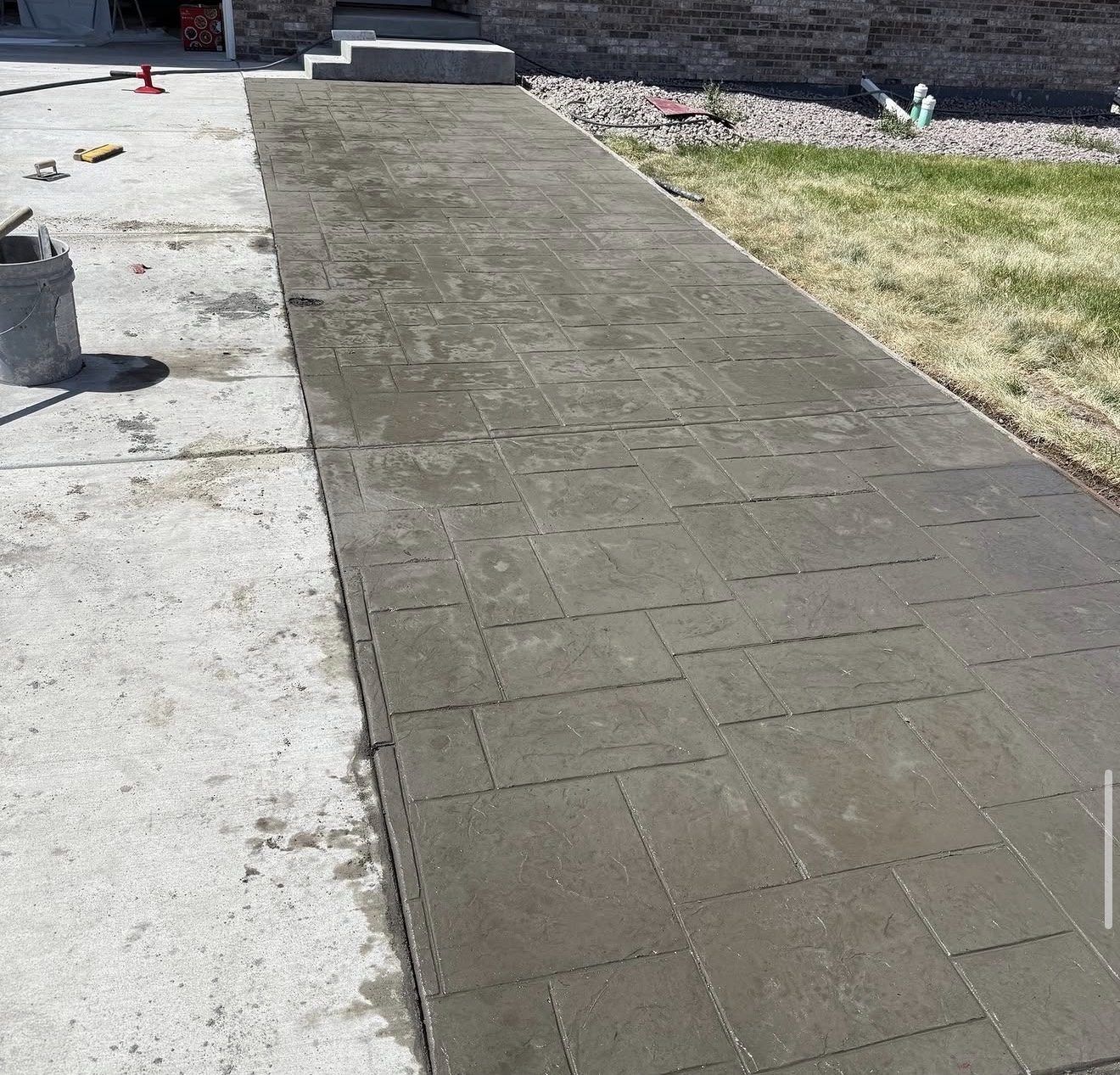
Stamped concrete copies a material. PCA lists cobblestone, brick and tile patterns, and Sika describes stamping to simulate brick, wood and stone. The texture is real, so from across the yard the slab reads as stone.
Stained concrete copies a finish. Acid stain looks variegated, a little like marble or weathered stone. Water-based stain looks more even. The two can be combined, since PCA says stains can go over colored concrete.
Judge color on real concrete, not a chart. Sika's stain data sheet says the final color is unique to each surface, and its sheets call for test sections first. You can see finished work in our project gallery.
Weighing pavers too? See stamped concrete vs pavers.
Freeze-thaw damage starts in the concrete, not the color. NRMCA explains that when saturated concrete freezes, expanding ice stresses the surface until it flakes, which is called scaling. Deicers make it worse.
NRMCA ties most scaling to too little entrained air, too much water, finishing with bleed water on the surface, and poor curing. On every job we use an air-entrained exterior mix suited to freeze-thaw, finish by hand, saw-cut control joints, and give you cure instructions and dates.
The finishes differ at the top layer. Integral color runs all the way through, and a color hardener makes the surface harder. Stain lives in a thin layer near the top, and PCA's guide says stained surfaces may not suit exterior slabs in cold climates where snow removal would damage them.
PCA adds a trade-off. A floated surface takes stain well but wears faster under traffic. A hard steel-troweled surface holds color longer, but it gets slick when wet and loses freeze-thaw durability, so PCA does not recommend it outdoors.
NRMCA also advises skipping deicers the first winter and never using ammonium sulfate, ammonium nitrate or magnesium-based products.
The sun is stronger here. The EPA says UV intensity rises about 6 percent per kilometer of elevation, and the National Weather Service lists a forecast point near Colorado Springs at 5,997 feet. The Colorado Climate Center notes that our thin atmosphere lets more solar radiation through.
What fades depends on what does the coloring:
So a faded patio is often a worn sealer. ASCC notes that sealing a surface left unsealed for years can bring the color back.
Sealer changes how concrete feels underfoot. ASCC says texture matters as much as gloss, and slip resistance should be addressed at the first sealing and every reseal.
The common fix is a grit additive mixed into the sealer, with enough on outdoor walkways to feel with a bare hand. ASCC notes grit does not make a surface totally non-slip, and ice is slippery no matter what.
A textured stamp pattern gives your feet more to grip than a smooth stained slab. For pool decks and steps, Sika's data sheets call for testing the finished system wet and dry, which is a fair thing to ask any contractor about.
Both finishes rely on sealer, and ASCC calls it a sacrificial coat that wears and needs reapplying. Its rule of thumb: high-traffic and sun-exposed areas every 2 to 3 years, lighter-traffic and interior areas every 4 to 5. Faded or blotchy areas, especially when wet, mean it is time.
PCA says sealers on stamped concrete often go on about 28 days after placement. ASCC says at least 75 percent of the powdered release should be removed first, because leftover release is one of the most common reasons sealer flakes off.
For timing before cold weather and safer ice melts, see sealing concrete before winter.
Expect close, not perfect. NRMCA says repair material will not match the color and characteristics of the original concrete.
Stamped. A replaced section is new concrete, color and stamping from a different batch on a different day, so it may look slightly different beside the old slab.
Stained. A worn stained slab can often be cleaned, recolored in spots and resealed, and PCA notes dyes can fill areas that did not take stain. Sika warns that older, weathered concrete can be hard to chemically stain, so test a small area first.
Cracks have their own causes, covered in why concrete cracks in Colorado Springs.
| Feature | Stamped concrete | Stained concrete |
|---|---|---|
| When it is done | On pour day | After curing, at least 14 days per PCA |
| How color gets in | Integral pigment, color hardener, antiquing release | Acid stain, or water-based stain or dye |
| Surface | Textured stone, brick, tile or wood pattern | Smooth or broomed, color only |
| Existing slab | No, needs a new pour | Often, if clean and sound |
| Sun | Pigment and hardener UV stable; sealer wears | Acid stain permanent, some shades interior only; sealer wears |
| Snow and shovels | Hardener adds surface hardness | PCA cautions on exterior stains in cold climates |
| Traction | Texture helps; add grit to sealer | Relies on finish and grit in sealer |
| Repairs | New sections may not match exactly | Spot recoloring possible; exact match unlikely |
Where each tends to fit:
Not sure which finish suits your yard? We offer free on-site estimates with a clear written quote, and the crew that measures your job is the crew that pours it. Request your free estimate or call (719) 437-3658.
Neither wins everywhere. Stamped concrete adds real texture and pattern and has to be done on pour day. Stained concrete adds color to a cured slab, sometimes an existing one, but stays smooth or broomed. For outdoor slabs that get shoveled in a snowy climate, Portland Cement Association guidance is more cautious about stains, so stamped often suits Colorado Springs patios and driveways better.
Reactive acid stains form color inside the concrete surface, and manufacturers describe that color as permanent, though a few green and turquoise shades are limited to interior use. Water-based dyes range from good to poor UV resistance. The layer that most often fades or yellows is the sealer, whose UV inhibitors can weaken after about three years, so resealing on schedule protects the color.
It can be, mostly because of the sealer. Gloss and the texture of the pattern both affect traction. The usual fix is a grit additive mixed into the sealer, and outdoor walkways should have enough to feel with a bare hand. Grit improves traction but does not make any surface slip-proof, and ice-covered concrete is slippery no matter what.
The ASCC Decorative Concrete Council's rule of thumb is every 2 to 3 years for areas with heavy traffic or strong sun, and 4 to 5 years for lighter traffic or interior areas. Most Colorado Springs driveways and patios sit in full sun, so plan on the shorter interval and reseal sooner if the color looks faded or blotchy when wet.
Yes. The Portland Cement Association notes that chemical stains can be applied over colored concrete, with the base color acting as a background for the stain. The concrete should be cured first, at least 14 days by PCA guidance, and free of sealer and curing compounds so the stain can soak in. Test a small area to see the real color.
Often, yes. Reactive stains work on old or new concrete, but the slab must be clean, sound and free of sealers, paint and curing compounds. Older, weathered concrete can react weakly, and stains are translucent, so patches and blemishes show through the color. A small test area shows what the finished color will actually look like on your slab.
Keep reading
An honest look at stamped concrete and pavers on Colorado Springs clay: frost, cracking vs shifting, weeds, repairs, sealing and ice melt.
Read the article →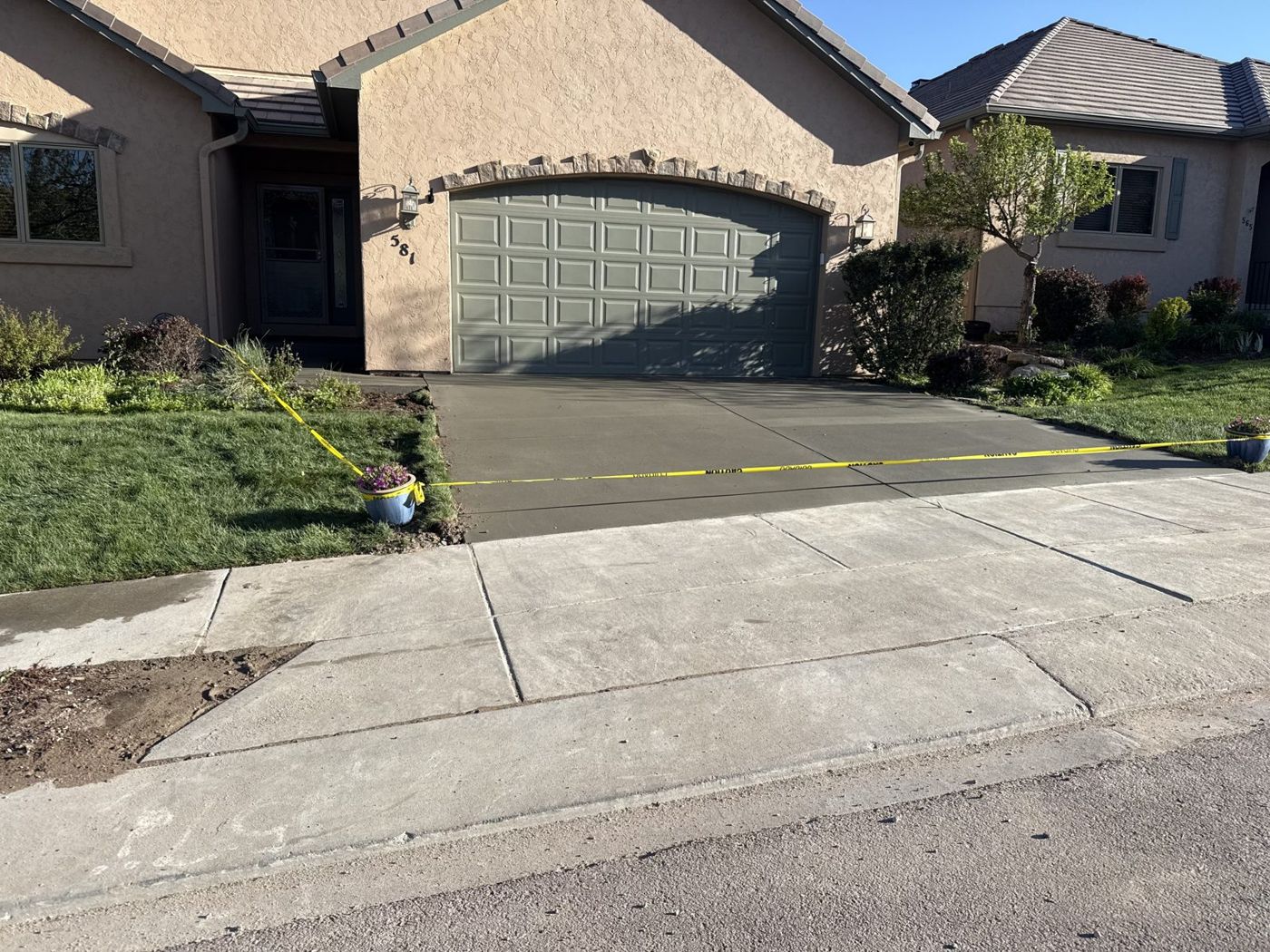
Why driveways crack in newer Falcon and Banning Lewis Ranch subdivisions, how to read the damage, and what replacement involves.
Read the article →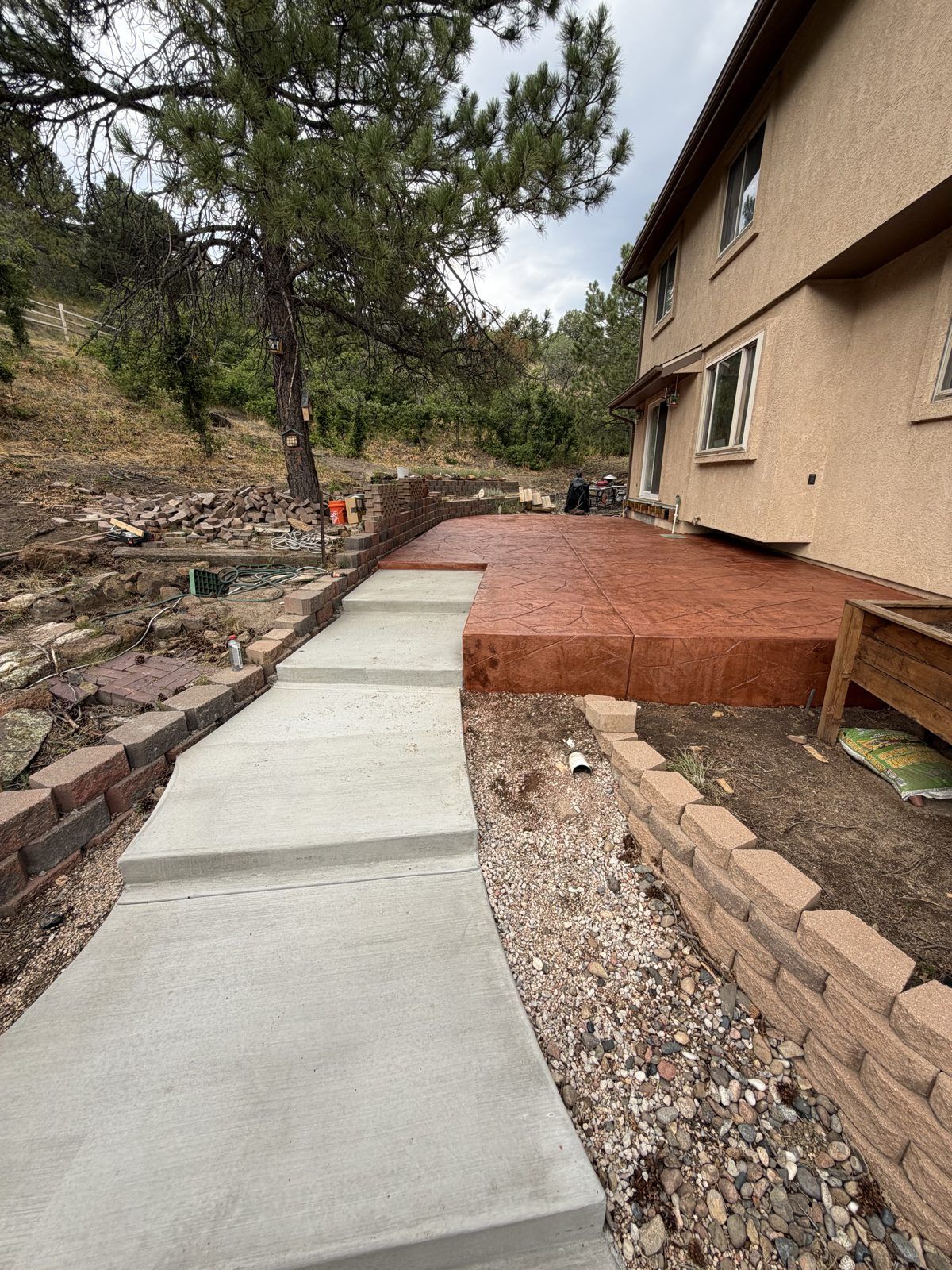
Who repairs the sidewalk in front of your house, when you need a permit, and how wide and sloped a new walkway should be in Colorado Springs.
Read the article →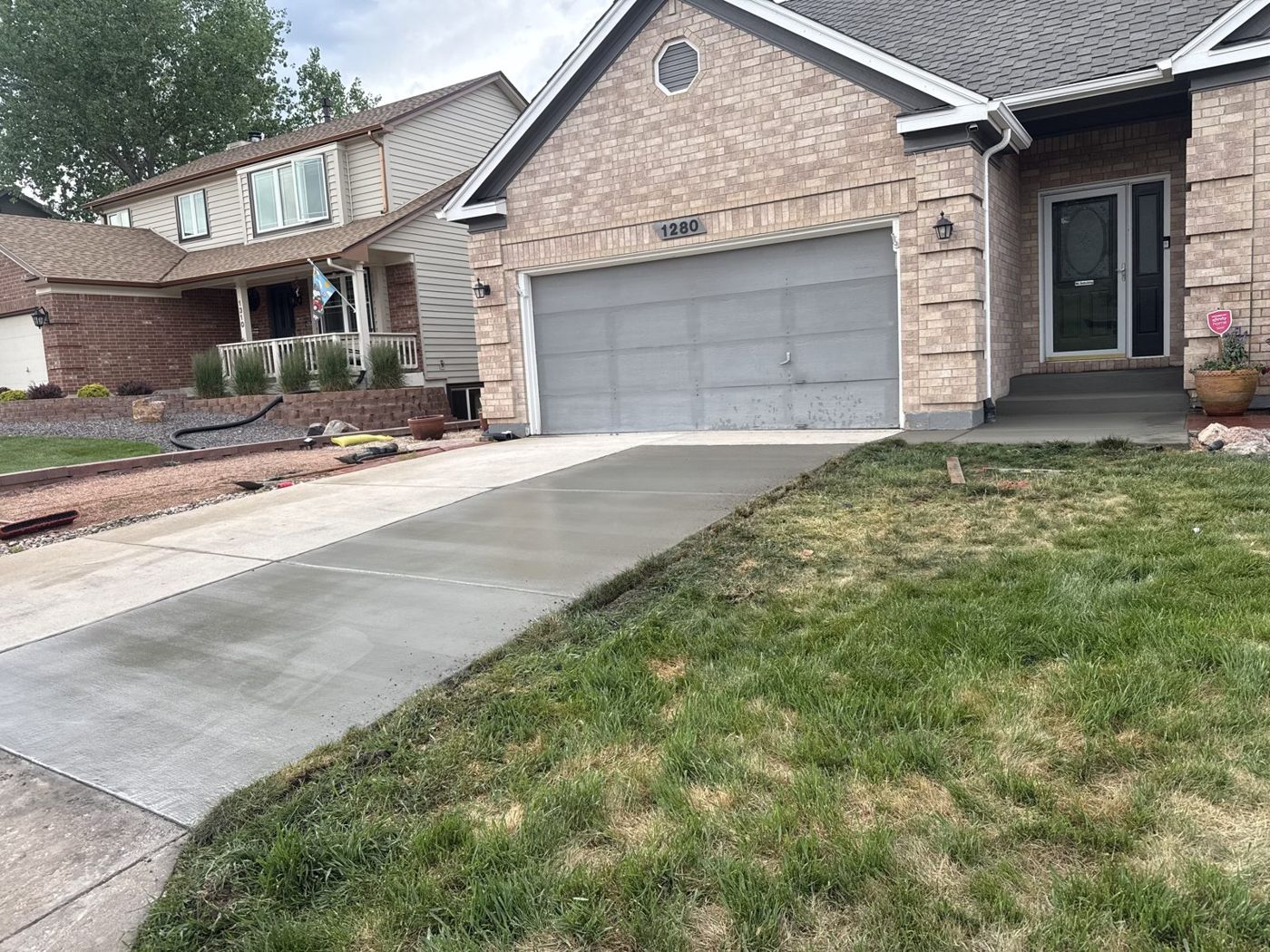
Free on-site estimate. We look at it, measure it and give you a clear written quote.